
PUBLIC HEALTH INITIATIVE • DIGITAL GOVERNANCE • CREATOR ECONOMY
Cognitive Sustainability:
Rebuilding the Human Infrastructure of the Internet
A clinical, systems-level diagnosis of the Utility Tax—the hidden cognitive and emotional cost paid by educators, clinicians, researchers, and mission-driven creators in the attention economy.
By Dr. Wadih Rhondali, MD, PhD Psychiatrist (occupational burnout) & Systems Strategist
The Utility Tax: when distribution requires self-extraction
For a decade, the internet promised frictionless transmission: that physicians, educators, and researchers could share high-utility knowledge directly with the public. That promise has quietly collapsed under algorithmic optimization.
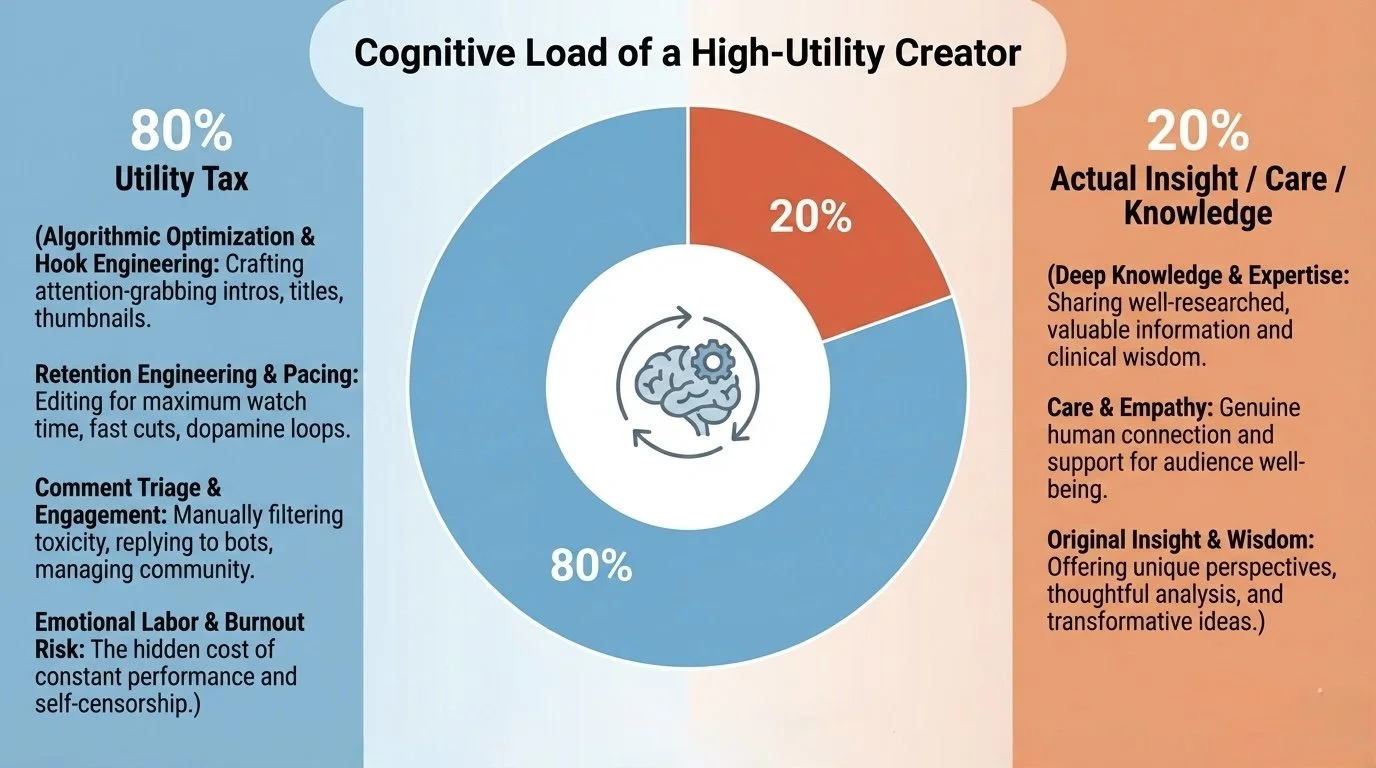
To exist in the public digital space today, it’s no longer enough to be accurate, useful, or humane—you must be performant. Mission-driven creators are forced to pay what I call the Utility Tax: the additional emotional and cognitive labor required to compress nuance, care, and truth into a format that satisfies systems optimized for the most reactive layers of the human nervous system (friction, outrage, comparison, retention loops).
In practical terms, many “helpers” spend the majority of their creative energy not producing value—but engineering attention: redesigning the hook, simplifying the insight, over-clarifying the point, softening the tone, and anticipating misreadings—simply to earn the right to be seen.
This is not communication. It is structural extraction.
When the wrapper costs more energy than the gift, the model is extractive.
The Clinical Reality: Burnout as an Occupational Pattern
In my clinical practice, I treat severe occupational burnout in healthcare professionals and executives. Over the last year, I have observed the same patterns emerging—at scale—in digital creators, especially those who carry public-interest work: mental health educators, physicians, therapists, teachers, journalists, and researchers.
The symptom cluster is strikingly consistent:
Anxiety indexed to dashboards (reach becomes a nervous-system trigger)
Compulsive checking (metrics as intermittent reinforcement)
Identity fusion (self-worth merges with performance indicators)
Visibility labor exhaustion (the cost of being constantly “available”)
Emotional depletion from packaging depth into short-form performance
When someone whose vocation is to help is forced to calibrate empathy to metrics, the outcome is not “lack of resilience.”
It is an induced occupational pathology—driven by platform design.
A Collapse of “Human Infrastructure”
(and a Quiet Exit from Public Space)
The internet does not only run on software. It runs on human infrastructure: people who translate complexity into clarity, who hold nuance, who teach, who care, who make meaning.
When that infrastructure is taxed beyond capacity, two predictable things happen:
1. High-utility creators burn out and reduce output—or leave entirely.
2. The next generation adapts by withdrawing from the public feed, moving toward private channels and closed networks as a form of cognitive self-defense.
This is not a moral panic. It is an ecosystem signal: a public sphere optimized for reflexes will eventually repel depth—and exhaust the people who try to provide it.
The Next KPI: Cognitive Sustainability (S₍c₎)
We can no longer treat human attention as an infinite resource. The current model extracts cognitive energy the way an extractive industry depletes a natural ecosystem—until the system fails.
The defining challenge of this decade is not only artificial intelligence. It is cognitive sustainability: designing digital environments that recognize human nervous-system limits and protect the people doing high-utility work.
Principles of regenerative algorithms (by design):
Reward time, depth, and signal quality, not only friction and speed
Reduce the Utility Tax imposed on educators, clinicians, and researchers
Protect human agency by lowering compulsive loops and rage-based amplification
Treat the digital public sphere as a form of public health infrastructure

If recovery collapses, sustainability collapses—regardless of reach.
Practical Tools
A self-administered occupational health diagnostic for creators who want to grow without breaking.
A protocol for algorithm hygiene and cognitive sustainability: stop hate-watching, reset baseline, and direct attention toward helpers.
Resources are free. No email required